Hey there!
I am so excited to tell you about the book I am linking up today!
We teach explorers in 4th grade. It seems that states teach different ones. However, one that is usually a common one amongst them is Christopher Columbus. To be quite honest, the only thing that I really knew about Christopher Columbus was that he discovered America. That's the only thing that I ever remember learning about him.
Well, this book will change your mind about how wonderful Christopher Columbus was! Since he discovered America, you'd assume he's a great guy...a hero, even. Well, he was definitely famous, but I'm not sure about the rest. If you have never thought about this, you've got to check out this book!
Here is the summery by Amazon (they are much more concise than I am!)- When Christopher Columbus landed on the island of San Salvador in 1492, what he discovered were the Taino Indians. Told from a young Taino boy’s point of view, this is a story of how the boy tried to warn his people against welcoming the strangers, who seemed more interested in golden ornaments than friendship. Years later the boy, now an old man, looks back at the destruction of his people and their culture by the colonizers.
Now, before we teach explorers, we have already taught about several Native American tribes. So, students already have a connection to how the Native Americans lived. This is definitely helpful when we read this book.
Jane Yolen (who I LOVE) wrote this story from a Taino boy's point of view. She has a page at the end of the book that gives facts and information about Columbus's voyages and what he did, including taking many Taino back with him to Spain to show King Ferdinand and Queen Isabella and then those Taino people became slaves.
This is a great book for teaching perspectives and point of view. It is also great for inferencing. Since the boy has never seen white people before, or many of the things they bring with them, the boy explains things based on what he knows, so students can figure out what the boy must be talking about. Here are a few pictures of the book so you can see what I'm talking about!
By the way, David Shannon is the illustrator in this book and he did an AMAZING job. The illustration tell as much of the story as the words do! Sorry for the bad pictures- I was getting a horrible glare so they are dark!
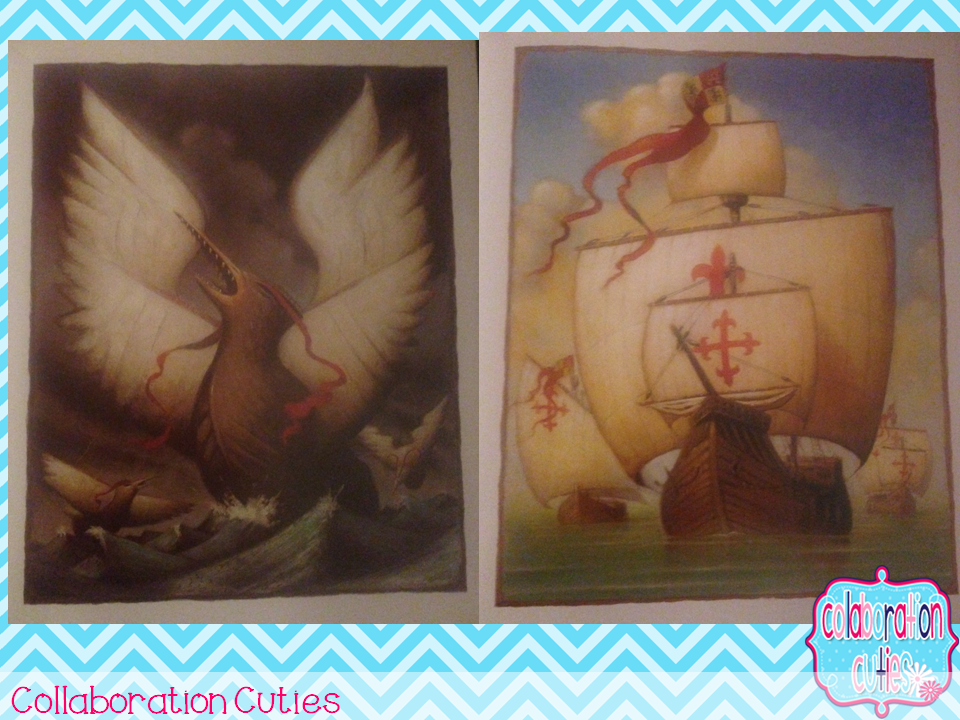
The first picture is from when the Taino boy has a dream (which he takes to be a warning) of three great birds sitting in the bay. This is the very first page of the book. You turn the page, and then you can see the three ships (or great canoes as the boy calls them).
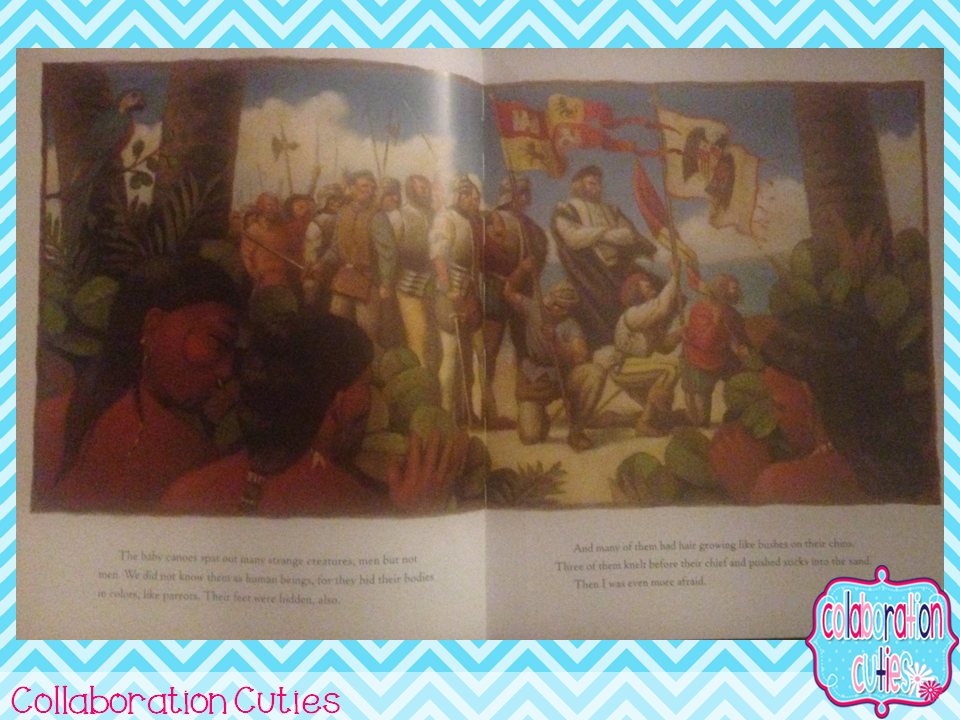
Here, the tribe is trying to figure the men out. Look at the language from this page. There is a lot of great figurative language in this book- personification, similes, and metaphors- because the boy is trying to compare what he sees to what he knows in order to make sense of it all. Here's what the page on the left says, "The baby canoes spat out many strange creatures, men but not men. We did not know them as human beings, for they hid their bodies in colors, like parrots. Their feet were hidden, also."
The second page says, "And many of them had hair growing like bushes on their chins. Three of them knelt before their chief and pushed sticks into the sand. Then I was even more afraid."
This is just a great way for students to see the boy's point of view!!
Here is another great page for inferencing!
This is a great page to use the illustration to help figure out the things that Columbus gave the Taino as gifts.
Look at this illustration!! Can YOU make an inference on how the boy saw Columbus?!? This illustration definitely makes an impact!!
I usually read this book 3-4 times over a week long period. So far, I've read it 3 times. I'll be honest, before I read this book last year, I was one of those people who didn't always think you should reread books again and again and I'd always cringe when I'd pull out a new book that I was so excited about and ask "Has anyone ever read this book?" and hands fly up. I'd be disappointed because it's so hard for them to predict, etc, when they've already read it. BUT, this book changed all of that for me. The more times you read this book to the class, the more they see and the more they can connect it to what they are learning about with the explorers.
I use this book to talk about author's purpose, main idea, summarizing, figurative language, and the biggie- INFERENCING. I actually have a unit in our
TpT store that goes with this. And this unit can be as easy or as hard as you want to make it. I use this book to introduce making inferences by using evidence from the text to back it up and also using facts and information we are learning about explorers and what we learned about Native Americans. I do these whole group because these are my modeled lessons. It's one of my very favorite units!!


We do these lessons over at LEAST a week, sometimes two. The first time we inference, it's more of them trying to figure out what the boy is thinking. The second time we inference (after the 3rd reading) we use evidence to support our thinking. I wish that I had taken pictures of the sticky notes from all of their inferencing but I forgot. I'll have to add them when I go to school tomorrow. We tried on each page to really think deeply about events and the characters.
This is a great book for critical thinking and for students to see how it can be beneficial to reread because they may find something they didn't see the first time. I highly recommend it, most especially if you teach explorers! This is how I kick off the unit. I read it during social studies the first time. The other times I read it in language arts. I hope you'll check this book out, even if you don't teach explorers!! I'll tell you one thing, once you and your students read
Encounter by Jane Yolen, you'll see explorers in a different light!
I hope everyone has a great week!
Amanda
Please Link Up!
Next week's linky- Language Arts